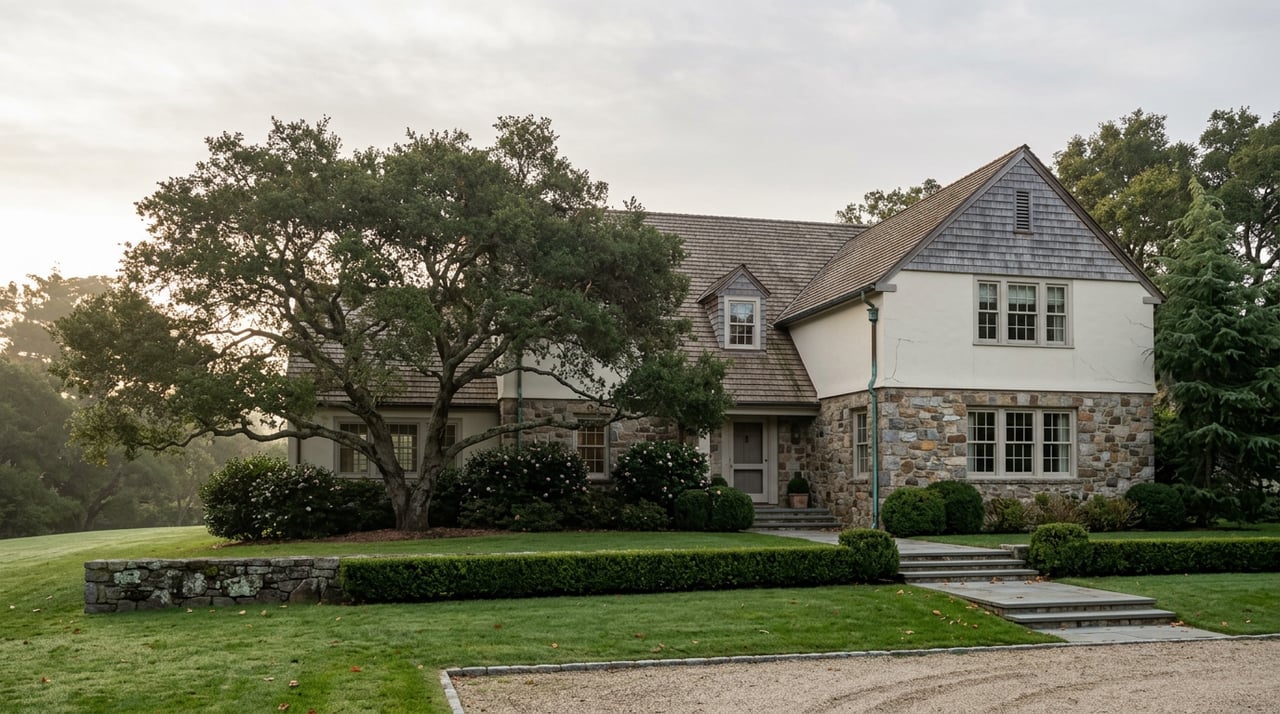
For a century, the phrase "Atherton acre" meant something specific and unmovable. Town officials coined it in the 1920s for the original minimum lot size, a shade under a full acre at 0.92 acres, and that number became shorthand for the town's whole identity: one house, one enormous lot, no exceptions. Buyers who paid a premium for Atherton were paying for that guarantee as much as for the house itself.
Starting in 2022, the guarantee cracked. A property at 2 Lowery Drive, a 1.22-acre parcel with a one-story, five-bedroom home built in 1960, became the first lot in Atherton approved for a split under California's SB9, with the final map on track to be recorded by San Mateo County in early 2023. The original parcel was divided into two new lots, roughly 0.51 and 0.69 acres, and a second address, 77 Edge Road, appeared where there had been only one. Each resulting parcel was cleared to build up to 4,500 square feet above grade plus a detached ADU of up to 1,200 square feet. A property that had been sold as a single estate lot for $5.6 million in December 2021 became, on paper, two.
That single filing is the reason a buyer comparing Atherton lots today by price per acre is measuring the wrong thing. The number on the flyer describes what the parcel is. It does not describe what the parcel is allowed to become, and those two facts have started to diverge in ways that reward some sizes of lot more than others.
What the split actually changed
SB9 gave California homeowners a ministerial right, meaning town staff must approve a qualifying split without a public hearing, to divide a single-family lot into two parcels as long as neither resulting lot falls below 40 percent of the original size. Atherton adopted its own objective standards for these splits under a distinct chapter of its municipal code, separate from the standard floor area formulas that govern ordinary R-1A and R-1B lots. That distinction matters more than it sounds like it should: a split parcel does not simply inherit a smaller slice of the same rulebook. It falls under its own chapter, with its own floor area ceiling, which is how two brand-new sub-acre parcels at 2 Lowery Drive and 77 Edge Road each ended up with the same 4,500-square-foot cap regardless of their slightly different final sizes.
For a town whose entire premium rested on one lot equaling one house, that is a structural change, not a paperwork footnote.
The formula hiding inside every listing
Even setting SB9 aside, Atherton's own zoning code treats lots above and below one acre, 43,560 square feet, differently in a way most flyers never explain.
A lot at or above one acre in the R-1A district gets a flat floor area ratio of 18 percent. A lot below one acre uses a different formula entirely: floor area in square feet equals the lot's square footage multiplied by 0.163, plus a flat 726 square feet, with a floor of 2,250 square feet no matter how small the parcel.
Run the math on a half-acre lot, 21,780 square feet, and the formula yields about 4,276 square feet of allowable floor area. A naive 18 percent calculation on that same lot would suggest only about 3,920 square feet. The added 726-square-foot base actually gives smaller parcels a proportional cushion that a flat percentage would not. It is a small mechanism with a large effect: it means a buyer eyeing a sub-acre Atherton parcel, whether created by a recent split or simply smaller from the start, is not automatically getting a proportionally smaller house. The formula was built to soften that penalty.
Slope changes the math again
Floor area is only half the constraint. Before a lot can even be subdivided, it has to clear Atherton's subdivision minimums, and those minimums scale with slope rather than staying fixed at one acre town-wide.
| Average cross slope | Minimum lot area | Minimum width | Minimum depth |
|---|---|---|---|
| Under 20% | 1 acre | 175 feet | 200 feet |
| 20% to 34.9% | 2 acres | 200 feet | 200 feet |
| 35% or more | 5 acres | 300 feet | 300 feet |
A flat one-acre parcel and a hillside one-acre parcel are not interchangeable under this table. The flat lot could theoretically support a split someday if it met all other standards. The hillside lot at 35 percent slope needs five times the land before subdivision even becomes a conversation. Two listings advertising the same acreage can be sitting on completely different levels of future flexibility, and the difference is buried in a topographic survey, not the listing description.
The oak that outranks the survey
Atherton's Heritage Tree Ordinance adds a third variable that has nothing to do with lot size at all. Any oak, specifically valley oak, coast live oak, or blue oak, with a trunk circumference of 48 inches or more, roughly 15.2 inches in diameter measured at 54 inches above grade, is protected anywhere on the lot, including inside the area where a house would normally go. Other tree species trigger the same protection only if they sit outside the main buildable area, meaning in the setbacks.
That distinction is easy to miss and expensive to discover late. A non-oak tree in a side yard might be removable without much friction. A qualifying oak sitting in the middle of a buildable envelope is not, regardless of how large the surrounding lot is. A five-acre parcel with a legacy oak positioned badly can end up with a tighter effective building footprint than a much smaller lot with a clean survey.
Why the price-per-acre comparison misleads
Put the three mechanisms together and the shape of the real question comes into focus. Floor area ratio does not scale evenly across the one-acre line. Subdivision minimums do not scale evenly across slope categories. Heritage tree protection does not scale with lot size at all. A buyer who compares two Atherton parcels purely on price per acre is treating three independent variables as if they were one.
This is also why Atherton behaves differently from its immediate neighbors. The town has no commercial zoning of any kind, so daily errands route to Menlo Park's Santa Cruz Avenue or nearby Redwood City rather than anything inside town limits. That residential-only structure is precisely what has kept large lots the norm for a century. It is also why a zoning mechanism as narrow as SB9's 40/60 split rule can matter so much here: in a town built entirely around the assumption of one house per large lot, any crack in that assumption changes the calculus for every parcel near the threshold, not just the one that gets split.
The practical takeaway for anyone comparing Atherton properties is straightforward. The acreage figure is a starting point for a conversation with the zoning code, not a finished spec. What a specific parcel can actually support depends on its slope classification, its floor area calculation under the applicable chapter, and what is standing on it.
A few questions that come up often
Does every Atherton lot qualify for an SB9 split? No. Eligibility depends on meeting the 40/60 size rule after the split, satisfying frontage and access standards, and clearing any title restrictions such as CC&Rs, which SB9 does not override.
Are all mature trees protected the same way? No. Qualifying oaks are protected anywhere on the lot. Other species are only protected under the ordinance when they sit outside the main buildable area.
Does a bigger lot always mean a bigger allowable house? Not automatically. Floor area depends on which formula applies, whether the lot sits above or below one acre, and what standing trees or slope conditions limit the buildable envelope regardless of total acreage.
If you are comparing Atherton parcels and want to know what a specific lot's zoning file actually allows before you write an offer, or you are weighing whether your own property's acreage supports more than it appears to on paper, Stephanie Elkins can walk you through it. Request a Private Valuation to start with a clear picture of what your property can actually support, not just what the flyer says.